Strategic Engagement with Don Quijote De La Mancha: A Framework for Critical Thinking and Curriculum Design
In the landscape of classical literature, few works offer as much strategic depth for modern educators and learners as Don Quijote De La Mancha. While often categorized simply as a foundational text of Western canon, its utility extends far beyond historical appreciation. For professionals in education, content creation, and curriculum development, this masterpiece by Miguel de Cervantes serves as a robust vehicle for teaching critical analysis, narrative structure, and character psychology. However, approaching such a dense work requires more than passive reading; it demands a structured, intentional framework that aligns with rigorous educational standards while maintaining learner engagement.
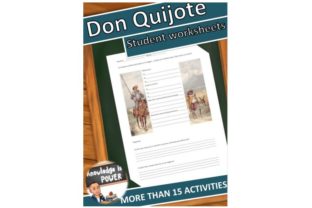
The challenge for many instructors and self-directed learners is bridging the gap between the archaic language or complex themes of the 17th century and the immediate, practical needs of 21st-century skill acquisition. This is where a curated, activity-based approach becomes essential. By utilizing a comprehensive resource package specifically designed around Don Quijote De La Mancha, educators can transform a potentially daunting text into a dynamic series of learning modules. Such resources, typically spanning approximately eight class hours, provide the scaffolding necessary to unpack the novel’s layers without losing sight of broader educational goals.
Aligning Classical Literature with Modern Educational Standards
One of the primary concerns for educators in grades 8 through 12, as well as those in higher education and homeschooling environments, is ensuring that instructional materials meet Common Core State Standards (CCSS). The integration of Don Quijote De La Mancha into a modern curriculum is not merely an exercise in literary history; it is an opportunity to develop reading comprehension, vocabulary acquisition, and analytical writing skills. A well-designed product containing varied activities ensures that every hour spent with the text yields measurable academic outcomes.
When selecting materials to support the study of this novel, look for resources that balance traditional analysis with interactive engagement. For instance, effective units often begin with a deep dive into character construction. Understanding the physical and personality traits of both Don Quijote and Sancho Panza is crucial. These two characters represent opposing yet complementary worldviews—idealism versus pragmatism. By analyzing their descriptions, students learn how authors use detail to build archetype and subvert expectation. This foundational knowledge sets the stage for more complex thematic exploration later in the unit.
Building Vocabulary and Comprehension Through Active Recall
Vocabulary acquisition is often treated as a rote memorization task, but within the context of Don Quijote De La Mancha, it becomes a tool for decoding meaning. Strategic learning materials incorporate puzzles and search activities that require students to engage with definitions actively. A crossword puzzle focused on reading comprehension forces learners to recall specific plot points and character motivations, reinforcing memory through retrieval practice. Similarly, a word search that refers directly to the text, requiring students to find definitions in a dictionary, bridges the gap between contextual guessing and precise lexical understanding.
This dual approach—contextual inference followed by definitive verification—mirrors the way proficient readers process complex texts. It encourages students to slow down and consider the nuance of language, a skill that translates directly to improved performance in standardized testing and professional communication. By embedding these activities early in the eight-class duration, instructors ensure that students have the linguistic tools necessary to tackle the more abstract themes of the novel.
Personalizing the Narrative: Identity and Thematic Analysis
Effective education connects the material to the learner’s lived experience. One powerful strategy in studying Don Quijote De La Mancha is inviting students to reflect on their own identities in relation to the text. An activity where students create their own coat of arms based on their interests and dreams serves multiple pedagogical purposes. It introduces heraldic symbolism and historical context while allowing for personal expression. More importantly, it creates a parallel between the protagonist’s constructed identity as a knight and the student’s own aspirations.
Following this personal connection, the focus shifts to structural analysis. Using a graphic organizer to map central and sub-themes helps learners visualize the architectural integrity of Cervantes’ narrative. This is not just about identifying themes like "madness" or "chivalry"; it is about understanding how these themes interact and evolve. When students can see the relationship between main ideas and supporting details, they improve their ability to construct coherent arguments in their own writing. This transition from personal reflection to structural analysis is a critical pivot point in deep learning.
Contextual Definition and Text Rendering
As students progress through the text, the complexity of Cervantes’ prose requires advanced decoding strategies. Text rendering activities, where students locate specific quotes and build definitions based on context, are invaluable. This method moves beyond simple comprehension checks to higher-order thinking. Students must analyze tone, intent, and situational context to derive meaning. This skill is directly applicable to real-world scenarios where professionals must interpret ambiguous communications, legal documents, or nuanced client feedback.
By grounding definition-building in actual quotes from Don Quijote De La Mancha, learners see language as a living, flexible tool rather than a static set of rules. This approach fosters intellectual agility, allowing students to navigate uncertainty with confidence. It also prepares them for the final stages of the unit, where synthesis and evaluation become the primary objectives.
Synthesis, Timeline Construction, and Critical Review
The culmination of any strategic study unit is the ability to synthesize information and form independent judgments. Writing activities that require summarizing and creating a timeline help students organize chronological events and distinguish between major plot drivers and minor details. This organizational skill is vital for project management and operational planning in professional contexts. Once the narrative structure is clear, students can engage in the expression of personal opinions through writing a formal review.
Crafting a review of Don Quijote De La Mancha requires students to balance subjective response with objective evidence. They must articulate why the text resonates or fails to resonate, supporting their claims with textual references. This mirrors the process of brand analysis, product evaluation, or strategic auditing in business environments. The ability to critique thoughtfully is a hallmark of mature intelligence and professional competence.
Risks of Unstructured Engagement
While Don Quijote De La Mancha offers immense value, approaching it without a clear plan carries risks. Without structured activities, students may become overwhelmed by the length and stylistic nuances of the original text. This can lead to superficial reading, where the deeper philosophical questions are missed in favor of plot summary. Furthermore, lacking guided vocabulary support can result in frustration and disengagement, particularly for learners who are not native speakers or who struggle with archaic syntax.
Additionally, failing to connect the text to personal relevance or modern applications can render the study abstract and disconnected. Students may view the novel as a relic rather than a relevant commentary on human nature. Therefore, the inclusion of diverse activities—ranging from oral discussions to written analyses—is not optional; it is necessary for maintaining momentum and ensuring deep comprehension.
Implementing a Strategic Approach to Literary Study
To maximize the benefits of studying Don Quijote De La Mancha, educators and learners should adopt a phased approach. Begin with character and context, move to vocabulary and structural analysis, and conclude with synthesis and critique. Utilize resources that offer comprehensive coverage, including reading, oral, writing, and comprehension activities. Ensure that the material is aligned with CCSS to guarantee academic rigor.
Whether you are teaching 8th graders, guiding high school seniors, or facilitating adult education courses, the key is intentionality. Do not let the text dictate the pace; instead, use structured activities to control the flow of information. By doing so, you transform a classic novel into a powerful tool for developing critical thinking, communication skills, and cultural literacy. The goal is not just to read Don Quijote De La Mancha, but to use it as a lens through which to better understand the complexities of narrative, identity, and human behavior.
In conclusion, the strategic use of a well-curated educational package centered on this masterpiece allows for a balanced, engaging, and rigorous exploration of one of literature’s most significant works. By focusing on practical outcomes and structured engagement, you ensure that the time invested yields lasting intellectual returns.